The honest range
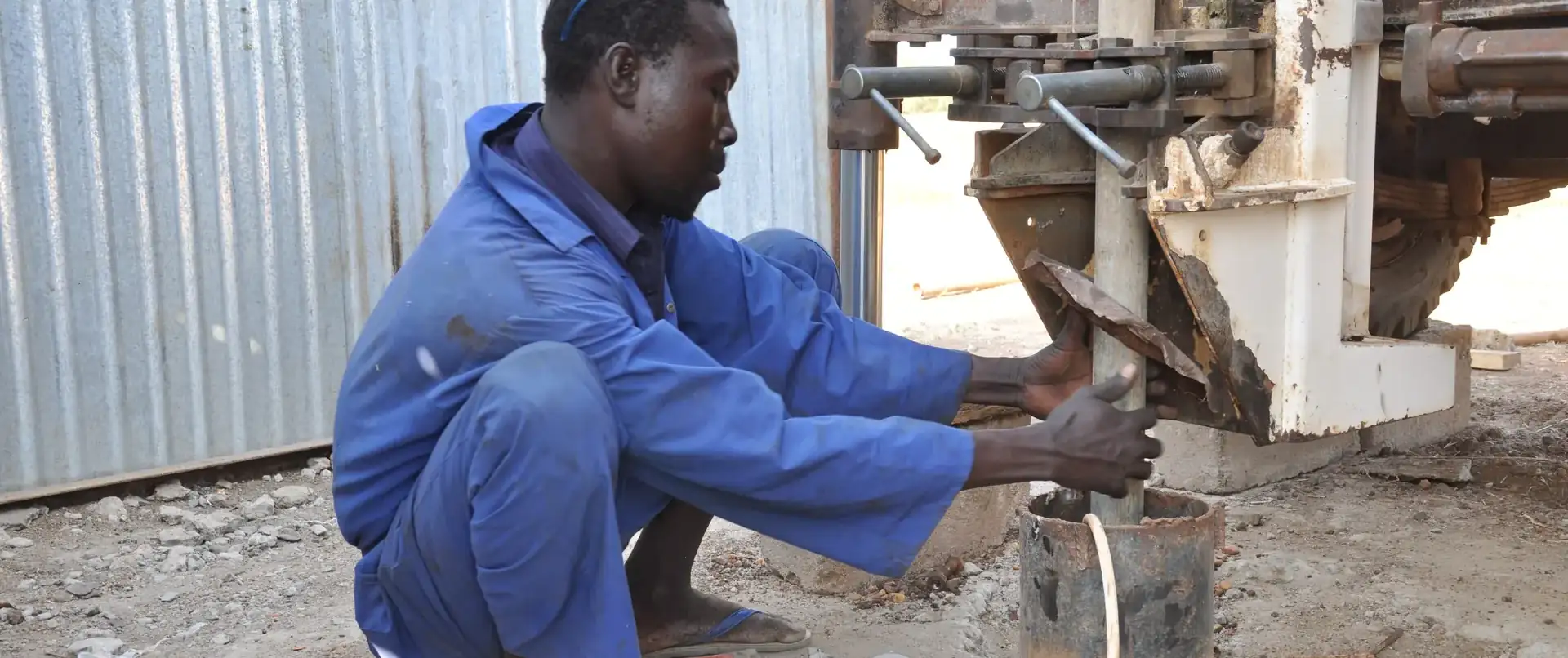
Across the districts where we work most, a community hand pump borehole in basement terrain usually finishes somewhere between 40 and 100 metres. Sedimentary and volcanic areas behave differently, and high-demand institutional or irrigation wells are often deeper because they need sustained yield rather than a few cubic metres a day.
Our rigs are capable of 450 metres, and that capability matters even when it is not used, because it means the decision to stop is made on hydrogeology rather than on the limits of the equipment.
What the crew watches as the hole advances
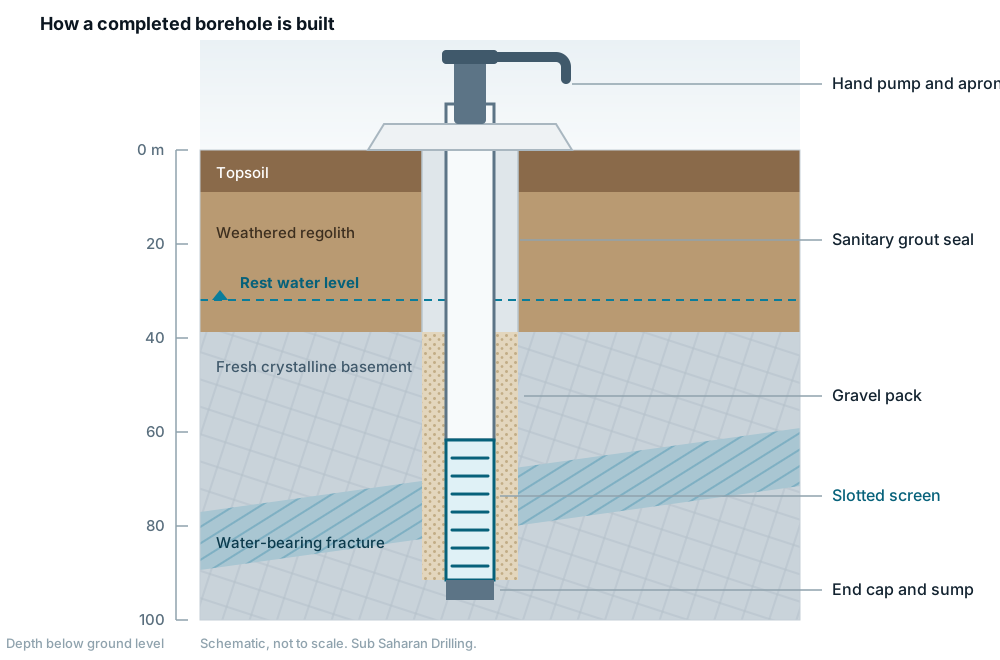
Air-rotary drilling gives the crew continuous feedback. Cuttings blown to the surface show the formation changing from soil, to weathered regolith, to fractured rock, to fresh rock. The rate of penetration slows sharply when the bit reaches competent rock. When a water-bearing fracture is intersected, the return changes visibly and the airlift yield can be estimated on the spot.
All of this is written into the lithological log, metre by metre. That log is the technical record of the well and the reason a later contractor can rehabilitate it intelligently instead of guessing.
Overburden water versus fracture water
Water struck in the weathered overburden is tempting because it arrives early and shallow. It is also the water most likely to disappear at the end of a long dry season, and the most exposed to surface contamination from latrines and livestock.
For that reason a well intended to serve a community year-round is normally taken into the fresh rock to intersect a fracture, and the overburden section is cased and grouted off rather than screened. Drilling shallow to save money frequently means drilling again in three years.
When to drill deeper, and when to stop
Past the sited depth, the question is whether the geology still suggests a target below. If the sounding indicated a fracture at 85 metres and the bit is at 78 metres in fresh rock with rising penetration resistance, continuing is rational. If the hole has been in fresh, unfractured, dry rock for 40 metres beyond the interpreted structure, continuing usually just buys a deeper dry hole.
We make that call with the client, not instead of the client, and we record the decision and its basis in the completion report.
Yield matters more than depth
Depth is a cost. Yield is the outcome. A 45 metre well delivering a stable 1.5 cubic metres an hour serves a village better than a 120 metre well that draws down to nothing after twenty minutes. This is what test pumping measures, and why a completion report without test pumping data tells you almost nothing about whether the water point will survive the next dry season.
Questions
What is the deepest borehole Sub Saharan Drilling can drill?
Our air-rotary rigs drill water wells to depths of up to 450 metres, with completed diameters from 100 mm (4 inches) to 1000 mm (40 inches).
Why did my neighbour hit water at 40 m when my well needed 90 m?
In crystalline basement terrain, water sits in weathered zones and fractures that vary over very short distances. Two sites a few hundred metres apart can have completely different depth to fresh rock and completely different fracture patterns.
Talk it through with the drilling team
Estimates are free and carry no obligation. Call +256 793 036 679 or send the details of your site.