FAQ
Everything clients ask, answered
31 questions on cost, depth, siting, water quality, pumps, maintenance and contracting, answered plainly by the people who do the drilling.
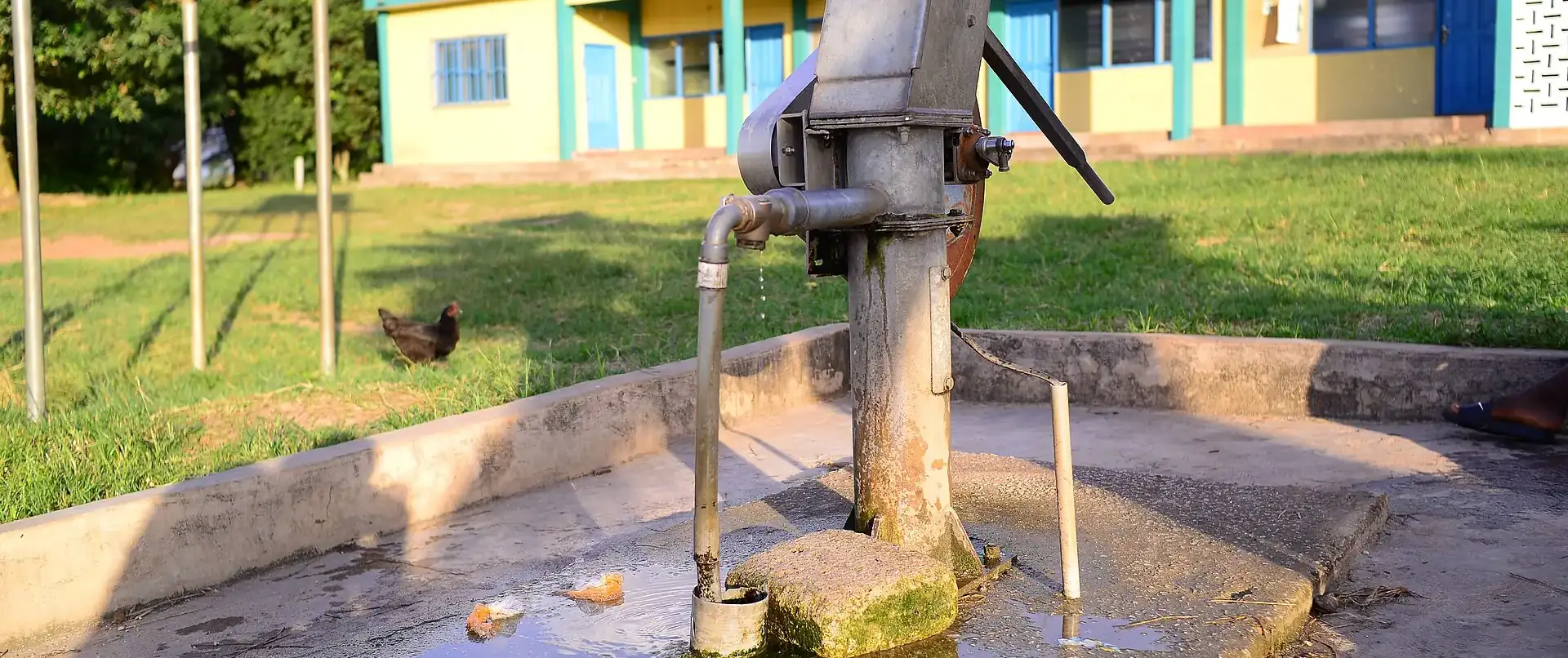
Photo: Amuzujoe, a hand pump and apron at an institutional water point. CC BY-SA 4.0, via Wikimedia Commons.
The basics
How deep can Sub Saharan Drilling drill a borehole?
Sub Saharan Drilling drills water wells to depths of up to 450 metres, with completed diameters from 100 mm (4 inches) to 1000 mm (40 inches), using air-rotary rigs.
Which countries does Sub Saharan Drilling work in?
The team drills across Sub Saharan Africa, principally in the northern, eastern and western regions of Uganda and in the Democratic Republic of Congo, and takes contracts in South Sudan, Kenya, Tanzania and Ethiopia.
How long does it take to drill and complete a borehole?
A typical community borehole is sited, drilled, cased, developed, test pumped and fitted with a hand pump within one to two weeks, depending on formation, depth and site access.
Do you provide a quotation before drilling?
Yes. Sub Saharan Drilling offers a free, no-obligation estimating service. Call +256 793 036 679 or send the contact form and an advisor will arrange a survey of the site.
Who are the clients of Sub Saharan Drilling?
Clients include international NGOs such as Unicef, MSF Holland, AMREF, World Vision, Oxfam, the World Food Programme, GOAL, Medair, Global H2O, Mercy Corps, Action Against Hunger and Caritas, as well as the Uganda Wildlife Authority, district governments and private landowners.
What drilling method and equipment do you use?
Sub Saharan Drilling uses air-rotary drilling. The rig and both compressors were completely overhauled in 2013, when the water drilling assets of ADT Africa were acquired together with the drilling and administration teams.
Cost and contracting
Is it cheaper to rehabilitate an existing borehole than to drill a new one?
Usually yes. Redeveloping, flushing and re-equipping an existing borehole, and rebuilding the apron and drainage, typically costs a fraction of a new well, because the drilling itself is the largest single cost. Rehabilitation only fails to make sense when the original hole was badly sited, badly cased or has collapsed.
Does Sub Saharan Drilling charge for a quotation or a site visit?
No. Sub Saharan Drilling offers a free, no-obligation estimating service, including a visit to assess the site. Call +256 793 036 679 or send the contact form.
How is a borehole priced?
A complete quotation is broken into eight line items: siting survey, mobilisation and demobilisation, drilling to a base depth plus a rate per metre beyond it, casing and screening, gravel pack and grout seal, development and test pumping, water quality analysis, and well head works including the pump. A single lump sum with no breakdown hides what happens when the hole goes deeper than expected.
What happens if the borehole is dry?
No contractor can guarantee water at a coordinate. What we do is reduce the risk with a proper geophysical survey and agree in writing, before mobilisation, who carries the cost of a dry hole and on what terms an alternative site is drilled.
How can we reduce the cost per water point?
Cluster the sites. Mobilisation is effectively a fixed cost per trip, so drilling eight boreholes in one district deployment costs far less per well than four separate visits. Combining new drilling with rehabilitation of existing wells in the same area has the same effect.
Technical questions
What is the deepest borehole Sub Saharan Drilling can drill?
Our air-rotary rigs drill water wells to depths of up to 450 metres, with completed diameters from 100 mm (4 inches) to 1000 mm (40 inches).
Why did my neighbour hit water at 40 m when my well needed 90 m?
In crystalline basement terrain, water sits in weathered zones and fractures that vary over very short distances. Two sites a few hundred metres apart can have completely different depth to fresh rock and completely different fracture patterns.
Can a survey guarantee that a borehole will produce water?
No. Geophysical surveying substantially raises the probability of a productive well and gives an expected depth, but it maps electrical properties rather than detecting water directly. Any contractor guaranteeing water at a coordinate is overselling.
Can Sub Saharan Drilling drill on a point sited by someone else?
Yes. We are happy to drill against a third-party siting report. We will review it first and tell you plainly if we think the point or the expected depth is wrong, before the rig mobilises.
Which hand pump is best for a deep borehole?
For deeper community boreholes in Uganda, deep-well lever pumps such as the U2 and the India Mark II are the standard choice, with the cylinder set below the lowest expected pumping water level. The U3 suits shallower settings.
Can you install a solar submersible system instead of a hand pump?
Yes. Where demand justifies it and an institution can maintain it, a solar submersible pump with a raised tank and tap stands delivers far more water per day than a hand pump. Ask for it when requesting a quotation.
Water quality and maintenance
Does Sub Saharan Drilling arrange laboratory testing?
Yes. Water quality sampling and laboratory analysis are part of a complete borehole contract, and the results are issued with the completion report.
What if the water fails a quality standard?
It depends on the parameter. Bacteriological failure normally means correcting the sanitary seal or apron and re-testing. Iron and manganese are usually handled with aeration and filtration. Fluoride and high salinity may mean the well is unsuitable for drinking and an alternative site is needed.
Does Sub Saharan Drilling rehabilitate boreholes drilled by other contractors?
Yes. We assess the existing well, redevelop and flush it, re-equip it where appropriate, and rebuild the apron and drainage works. If the well is beyond economic repair we say so rather than taking the contract.
How often should a hand pump be serviced?
Basic checks by the caretaker should be monthly, with a fuller service including seal inspection at least annually, and cup seals replaced on schedule rather than after failure.
Working with us
Can you work to our organisation’s reporting template?
Yes. We routinely prepare completion documentation in the formats required by international NGO donors and district water offices. Send the template with the tender or at contract signature.
Can you provide references from previous NGO contracts?
Yes. References are available on request, including from Global H2O, whose country manager confirmed acceptance of our completion reports, photographs and coordinates for a seven-borehole programme in Kitgum and Lamwo.
Have you worked under government contract before?
Yes. Sub Saharan Drilling completed its first Ugandan government contract in Pallisa District in November 2013, four new boreholes, and the team has delivered work in the districts of Pallisa, Kitgum, Pader and Lamwo.
Do you take rehabilitation-only contracts?
Yes. We assess, redevelop, flush and re-equip existing boreholes and rebuild apron and drainage works, and we tell you when a well is beyond economic repair rather than taking the money.
What is the largest diameter you can complete?
We complete wells in diameters ranging from 100 mm (4 inches) to 1000 mm (40 inches), which covers submersible pump installations and high-yield institutional supply.
Do you install solar pumping systems?
Yes. Where demand justifies it and there is an institution able to maintain the system, a solar submersible pump with a raised tank and tap stands delivers far more water per day than a hand pump.
Do you take short-notice or standby work?
Where the rig is not committed, yes. Availability depends on current programmes, so contact us early with an indicative window and we will tell you honestly what we can hold.
What drilling method do you use?
Air rotary. The rig and both compressors were completely overhauled in 2013, which keeps penetration rates high and downtime low on remote sites.
How quickly can you mobilise?
It depends on current commitments and the district. Contact us with an indicative window as early as you can and we will tell you honestly what we can hold rather than promising a date we cannot keep.
Do you work outside Uganda?
Yes. We take contracts across Uganda, South Sudan, Kenya, Tanzania, Ethiopia, DR Congo, and the team has drilled extensively in the Democratic Republic of Congo. Cross-border work is priced with customs, fuel logistics and clearance shown as separate line items.