The eight line items in a drilling quotation
A complete borehole is a sequence of separate operations, and an honest quotation prices each one. When a contractor gives a single figure with no breakdown, you cannot tell what happens if the hole goes 20 metres deeper than expected, or what you are owed if the well comes in dry.
- Hydrogeological siting survey, priced per site, sometimes per cluster of sites.
- Mobilisation and demobilisation, priced per move, covering rig, compressors, water bowser and crew.
- Drilling to an agreed base depth, priced as a lump sum for the base and a rate per metre beyond it.
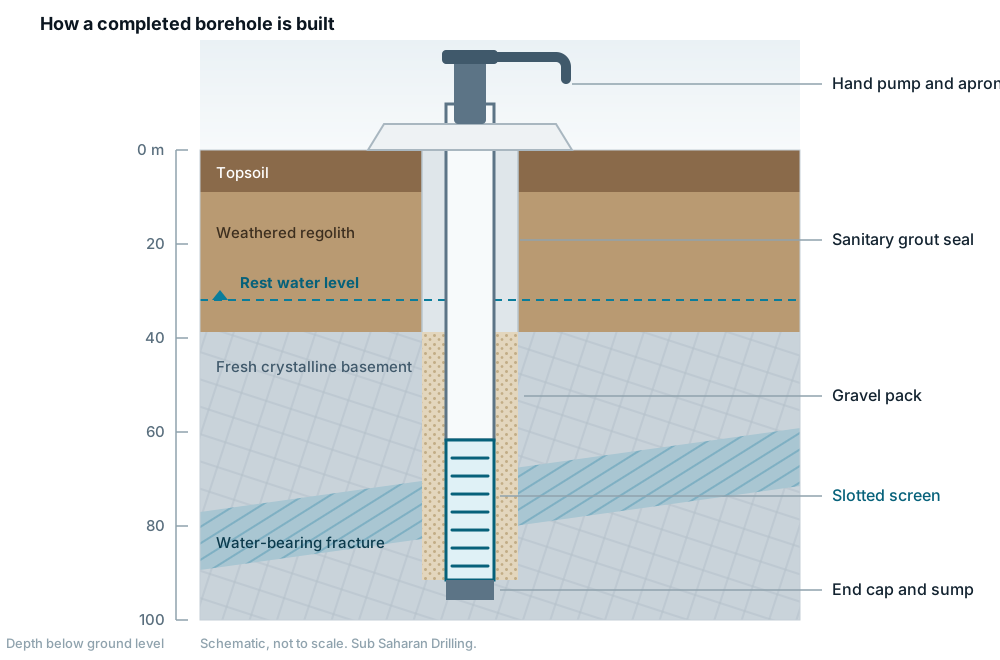
- Casing and screening, priced per metre, and varying with diameter and material.
- Gravel pack and sanitary grout seal.
- Well development and test pumping, usually priced per hour.
- Water quality sampling and laboratory analysis.
- Well head works: concrete apron, drainage channel, soak pit, and the hand pump itself.
Why depth dominates the budget
Every additional metre consumes fuel, compressor hours, bit wear and crew time, and each metre below the water strike usually needs casing or screen as well. In the crystalline basement rock that underlies most of Uganda, a productive fracture may be found at 40 metres on one site and not until 90 metres on a site two kilometres away.
This is why a fixed lump sum for an unknown depth is a bad instrument for both sides. Either the client overpays for the shallow wells to subsidise the deep ones, or the contractor loses money and starts cutting corners on casing and development. A base depth plus a transparent rate per metre keeps everyone honest.
Mobilisation and the economics of clustering
Moving a rig, two compressors, a water bowser and a crew into a district is expensive whether you drill one borehole or twelve. That cost is effectively fixed per trip, so it is the line item most within your control.
If your programme covers several parishes, drilling them in one mobilisation rather than four separate visits over a year can reduce the cost per water point substantially. The same logic applies to combining new drilling with the rehabilitation of existing wells in the same sub-county while the crew is already on the ground.
Who carries the risk of a dry hole?
No contractor can guarantee water at a specific coordinate. What a good contractor can do is reduce the probability of a dry hole through a proper geophysical survey, and be explicit about what happens if one occurs.
The usual arrangements are: the client pays for the dry hole at an agreed reduced rate and the contractor moves to an alternative site at reduced mobilisation; or the contractor carries the first dry hole and the client carries the second. Either is defensible. What is not defensible is leaving the question unanswered until the moment it happens.
The costs people forget
Three items are routinely missing from headline prices and then appear as variations later.
- Water for drilling. On sites with no nearby surface source, the bowser has to make long trips, and that is fuel and time.
- Site access. Cutting an access track, or hiring a grader in a wet season, is a real cost that no one budgets.
- Community mobilisation and water user committee training, which determine whether the pump is still working in five years.
How to compare two quotations fairly
Put both quotations into the same eight-line structure above. If one is missing a line, that is not a saving, it is a cost that will arrive later or a step that will be skipped. Check the casing specification in particular: uPVC class and wall thickness vary widely, and a thin casing that collapses in year three turns a cheap borehole into an expensive one.
Then check the deliverables. A borehole without a lithological log, test pumping data, water quality results and GPS coordinates is not auditable, and most donors will not accept it.
Questions
Is it cheaper to rehabilitate an existing borehole than to drill a new one?
Usually yes. Redeveloping, flushing and re-equipping an existing borehole, and rebuilding the apron and drainage, typically costs a fraction of a new well, because the drilling itself is the largest single cost. Rehabilitation only fails to make sense when the original hole was badly sited, badly cased or has collapsed.
Does Sub Saharan Drilling charge for a quotation or a site visit?
No. Sub Saharan Drilling offers a free, no-obligation estimating service, including a visit to assess the site. Call +256 793 036 679 or send the contact form.
Talk it through with the drilling team
Estimates are free and carry no obligation. Call +256 793 036 679 or send the details of your site.