Sector
NGOs and humanitarian programmes
Our drilling team has completed water programmes for Unicef, MSF Holland, AMREF, World Vision, Oxfam, the World Food Programme, GOAL, Medair, Global H2O, Mercy Corps, Action Against Hunger, Caritas and others across Uganda and the DRC.
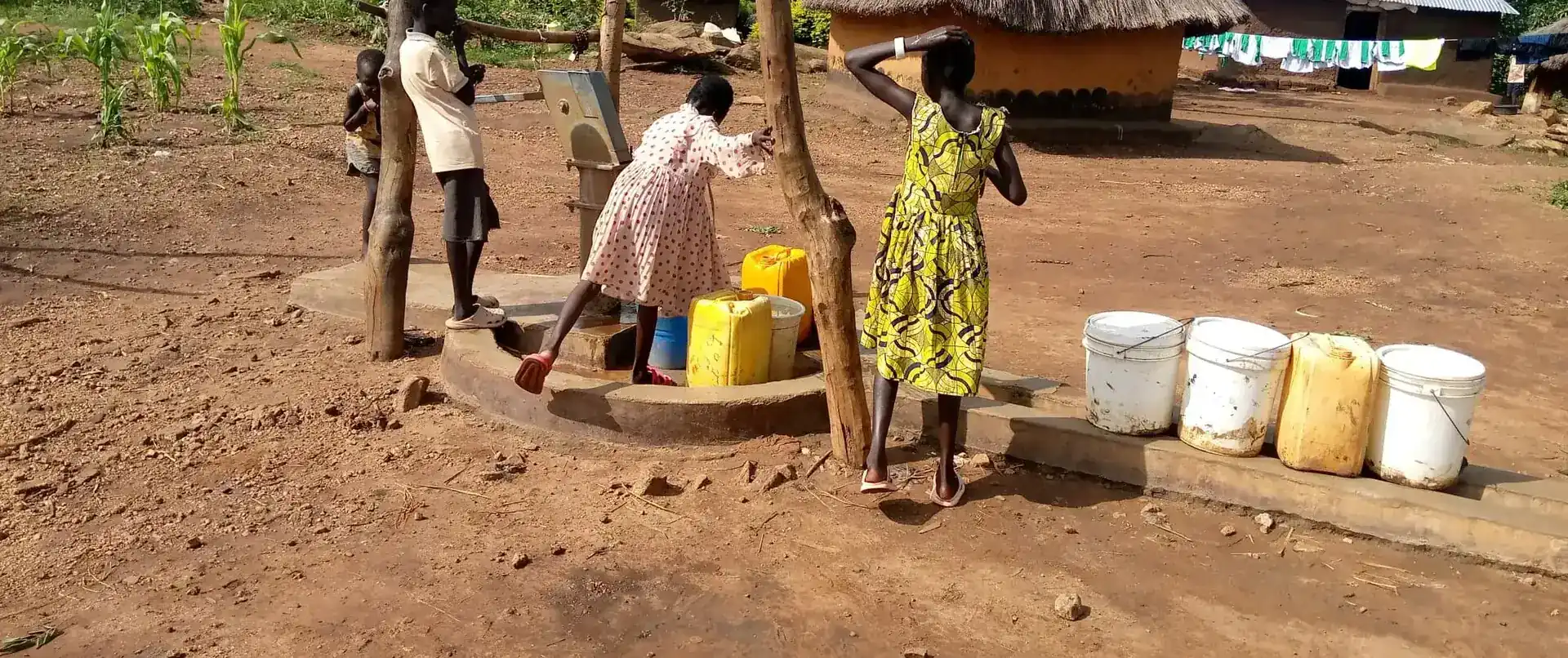
Photo: Moses Elly, a borehole in the Bidibidi refugee settlement, Uganda. CC BY-SA 4.0,
via Wikimedia Commons.
What this sector needs
The requirements that shape the contract
Documentation a donor will accept
Grant-funded water points have to be auditable. Every well we hand over carries a lithological log, water strike depths, casing and screen schedule, test pumping data, laboratory water quality results, GPS coordinates and dated site photographs, in the formats donors and district water offices expect.
Delivery inside a funding window
Grant timelines are unforgiving and rarely align with the rainy season. We plan mobilisations around access constraints and cluster sites so that a programme completes inside its window rather than carrying over into a reporting period where the money no longer exists.
Settlement and host community balance
In refugee-hosting districts, a water point that serves only the settlement creates friction with the host community. Where the programme design allows, we plan siting so that a single investment serves both populations.
Sanitation alongside water
Water supply on its own does not deliver a health outcome. We have combined borehole drilling with pit latrine construction under a single contract in refugee settlements, which removes the coordination gap between two separate contractors.
Our approach
How we run this work
- A single contractor from geophysical siting through drilling and construction to pump commissioning, so accountability never falls between parties.
- Clustered mobilisation across a district or programme area to reduce the cost per water point.
- Water user committee training and a written maintenance plan at handover, so the asset survives past the project closure date.
- Straight advice when a site is unsuitable or a rehabilitation would serve the beneficiaries better than a new well.
What you receive
- Siting report with coordinates, expected depth range and an alternative point
- Lithological log and water strike depths
- Casing, screen and gravel pack schedule
- Development and test pumping records with yield and drawdown
- Laboratory water quality analysis
- Photographic record and GPS coordinates of the completed water point
- Handover certificate and committee training record
Questions from this sector
Can you work to our organisation’s reporting template?
Yes. We routinely prepare completion documentation in the formats required by international NGO donors and district water offices. Send the template with the tender or at contract signature.
Can you provide references from previous NGO contracts?
Yes. References are available on request, including from Global H2O, whose country manager confirmed acceptance of our completion reports, photographs and coordinates for a seven-borehole programme in Kitgum and Lamwo.
Other sectors we serve
Discuss a contract